

Screens and Children: What the Data Really Shows
1. Why a Toddler’s Brain Isn’t Designed for Screens
Before the age of 6, the brain builds networks at an extraordinary rate. A young child can create tens of thousands of neural connections per minute. These connections are strengthened by the child’s experiences: voices, eye contact, touch, play, anticipation, boredom, laughter, and frustration.
A screen does the opposite of this mental exercise:
- it replaces turn-taking with a unidirectional flow;
- It imposes a pace of images and sounds that is too fast for an immature attention system;
- It reduces the time spent on engine play, drawing, hands-on activities, and conversation.
A common observation during consultations: a child who is “calm” while using a tablet but speaks very little, makes little eye contact, has a low tolerance for boredom, and is behind in the skills expected for their age.
French scientific societies have taken a tougher stance. Following the “no screens before age 3” rule, several experts commissioned for the 2024–2025 public research initiative have advocated avoiding screens before age 6—including so-called educational content—on the grounds that they are not suitable for a developing brain. This is not a generational whim. It is an interpretation of the data on language, attention, sleep, and social-emotional skills.
2. Language: the field where the evidence is most clear-cut
You don’t learn a language by watching someone speak on a screen. You learn it through interaction: the adult names something, the child vocalizes, the adult rephrases, the child points, and the adult smiles.
Several findings point in the same direction:
- Exposure starting in the morning and without adult interaction is particularly linked to language disorders. According to French data (Ille-et-Vilaine), the risk increases significantly with early exposure, and even more so when the child is left alone in front of the screen.
- Research conducted in Toronto had already shown that, at 18 months of age, 30 minutes of screen time per day could more than double the risk of delayed speech development.
- Speech-language pathologists working in the field report an increase of about 30 percent in the risk of language delays and behavioral disorders linked to early exposure.
- After the lockdowns, several countries saw a doubling in the number of requests for assessments of isolated language delays. Screen time isn’t the only factor (fewer days in daycare, less socialization), but it has acted as an amplifier.
In 2026, an international review covering more than 2.8 million children in 64 countries linked high screen time to poorer language development, lower academic performance, and greater emotional and relational difficulties. The magnitude of this association is significant: it rivals that of traditional factors such as socioeconomic status.
What this means in practice. Before age 3, no screen content has been shown to help children “learn to speak” better than a real adult. Between ages 3 and 6, if screen time is involved, only brief, infrequent use—accompanied by verbal commentary—can limit the damage. A child who “understands everything in English on YouTube” but doesn’t form sentences at home is not bilingual: they are often under-stimulated in terms of interaction.
3. Developmental Delay: What We See in the Clinic
Experts describe a pattern that is becoming increasingly common, especially among children between 18 months and 4 years of age:
- few words, few combinations of words;
- sparse pattern, weak imitation;
- repetitive activities (scrolling through videos, lining them up, channel-surfing);
- intolerance to screen time restrictions (violent outbursts);
- attention drawn by the movement, not by the face;
- fragmented sleep if you use a screen in the evening;
- Fine motor skills may develop later than expected (limited exposure to pencils and modeling clay).
It's not just "a kid who likes to stay home." It's often a result of not having been given enough human interaction.
The WHO’s recommendations remain a useful baseline: no sedentary screen time before age 1, and strict limits thereafter. In France, the official guideline has long been the 3-6-9-12 rule. The 2025 debate went further for children under 6, precisely because delays in language and attention are piling up in the waiting lists for speech therapy and early intervention.
4. “Virtual Autism”: What’s True, What’s False
This is the most sensitive issue. We need to say it plainly.
What Autism Is
Autism (autism spectrum disorder, ASD) is a real, heterogeneous neurodevelopmental disorder with a significant genetic component and early-onset characteristics related to social communication, interests, and sensory processing. It was not “invented by tablets.” Claiming otherwise perpetuates an old misconception: the search for a single culprit (vaccines, screen time) and delays in receiving appropriate care.
What Some Clinicians Do Observe, However
In 2018, Romanian psychologist Marius Zamfir coined the term “virtual autism” to describe children aged 0–3 who were often exposed to screens for more than 4 hours a day, with little physical play and few social interactions. These children exhibited signs similar to those of autism: minimal eye contact, limited language, repetitive behaviors, and intolerance to change.
In their clinical series, the “high-exposure” group showed greater improvement after screen time was eliminated and social interactions were reestablished, and required fewer hours of therapy than the group of autistic children with low exposure. Other clinicians (in France, Tunisia, and Thailand) have described cases in which symptoms subside after screen withdrawal and sometimes reappear if screen time returns to 3–4 hours per day.
Honest Reading
- These studies are observational, often small in scale, and sometimes non-randomized (it is ethically unacceptable to “leave” a group of children in front of a screen for 4 hours for comparison purposes).
- The term “virtual autism” is not a diagnosis in the DSM-5 or the ICD-11. Reviews from 2024–2026 consider it preliminary.
- The most plausible mechanism is not that “the screen creates an autistic brain,” but rather socio-sensory deprivation combined with overly rapid stimulation. The brain does not learn to read faces, to wait, or to vocalize. The condition mimics ASD.
A good rule of thumb to keep in mind. In some very young children who are heavily exposed, some of the “autism-like” symptoms are linked to the digital environment and may improve after withdrawal. In others, autism is a real condition; in these cases, screen time worsens the symptoms (fewer opportunities to learn, more meltdowns) without being the cause.
A simple clinical rule: if a 2- to 3-year-old child is showing concerning symptoms and spends 4 to 8 hours a day in front of a screen, turn off the screens immediately, encourage play and conversation, and assess the situation. Do both at the same time. Don’t do one instead of the other.
Key point: Autism is not “a false diagnosis caused by screen time.” However, excessive screen exposure at an early age can produce symptoms that resemble an autism spectrum disorder. Some of these symptoms subside when screen time is eliminated and social interactions are encouraged again. Confusing the two wastes time for children who are truly autistic and wrongly makes parents feel guilty.
5. “Before and After” MRI Scans: What the Brain Reveals
There is not yet a large-scale study in which the same child is assessed after “6 hours of screen time” and then after “3 months without screen time,” with a simple conclusion along the lines of “autism has disappeared, as shown in the images.”
However, there are longitudinal MRI studies. The Singaporean GUSTO cohort followed children for more than ten years. Screen time was reported during early childhood, followed by MRI scans at approximately 4.5 years, 6 years, and 7.5 years of age; decision-making tests were administered at approximately 8.5 years of age; and anxiety symptoms were assessed at approximately 13 years of age. Results: Exposure before age 2 is associated with premature maturation of networks linking visual processing and cognitive control—an early specialization that occurs before the connections necessary for more complex thinking are in place. Later on, this is linked to slower decision-making and more pronounced anxiety during adolescence.
This isn't a "snapshot of autism." It's a trace: the brain adapts to a world of fast-moving images, at the expense of other forms of learning.
7-tesla MRI scans, which are now available in France for children as young as 6, will open the door to further research on neurodevelopmental disorders. They do not, on their own, “prove” whether a child has autism or not.
The most useful “before and after” comparison today isn’t an MRI. It’s the clinical notebook: number of words, eye contact, play, sleep, seizures—at Day 0 and then 4–8 weeks into weaning. That’s often where parents see the difference.
6. The "little man" test: useful, but not a miracle cure
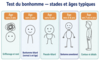
The Draw-a-Person test (Goodenough, sometimes referred to as the Goodenough-Harris test) asks the child to draw a person. Various elements are scored: head, body, arms, legs, fingers, clothing, profile, etc. An approximate mental age is sometimes derived from these scores.
Viral images—mostly from a German study by Winterstein and Jungwirth (2006) on 5- to 6-year-olds—contrast less than an hour of TV (a detailed figure) with more than three hours (a crude, bodiless “tadpole”). These images have been widely circulated to “prove” the harmful effects of screen time.
What You Need to Know:
- Drawing a stick figure primarily measures drawing skills and graphic vocabulary, not a reliable IQ. The correlation with traditional intelligence tests is weak.
- A French study has shown that differences related to screen time diminish or disappear when the family’s sociocultural background is taken into account. A child with little exposure to crayons, picture books, and preschool draws less skillfully, regardless of screen time.
- The “tadpole pose” (head + legs) is normal around age 3. Citing it as evidence of a serious problem in a child of this age makes no sense.
The test remains a supplementary tool: a 5- or 6-year-old child who produces nothing but a scribble, has never held a pencil, and spends four hours on a tablet raises questions about their overall stimulation. It is not an intelligence scanner.
Better than just watching the child alone: observe whether the child imitates, pretends, tells stories, follows two instructions in a row, points, or responds when called by name.
Here is An educational diagram of the "little man" test, showing the typical ages for each stage:
7. Other Harmful Effects, All Too Often Overlooked
Screens don't just affect language.
Sleep. Blue light and stimulation make it harder to fall asleep. A child who “falls asleep watching YouTube” sleeps less soundly and, as a result, learns less effectively the next day.
Warning: Channel-surfing trains the brain to expect immediate rewards. School, on the other hand, requires 20 minutes of work on a worksheet.
Body. Sedentary lifestyles, rising rates of nearsightedness, poor posture (“text neck,” rounded shoulders). For older children, this is already a topic of discussion in the doctor’s office.
Emotions. Less practice dealing with frustration. Turning off the screen turns into a crisis, and parents back down. The cycle perpetuates itself.
Relationship. “Technoference”: the parent is on the phone during a meal. The child learns that the adult’s face is not available.
8. Practical Guide: What to Do Based on Age
| Age | Practical Guide |
|---|---|
| 0–3 years old | Goal: No screen time for children (including “to get them to eat”). Short family video calls, supervised by an adult who is present, are the only use that is often tolerated. |
| Ages 3–6 | Ideal: as close to zero as possible. If used: for very short periods, with calm content, with an adult nearby who is talking, never in the bedroom, never in the morning before school, and never just to “shut them up.” |
| Ages 6–12 | Limited screen time, clearly posted schedules, no screens in the bedroom, no early exposure to social media, and a focus on real-world activities (sports, music, free play, and homework without YouTube playing in the background). |
Actions that make a bigger difference than words:
- Take an honest look at the situation: count every minute over a 7-day period (TV, tablet, a parent’s “borrowed” phone, YouTube in the kitchen).
- Announce the weaning process—don’t negotiate it minute by minute. For a very attached toddler, weaning is often intense during the first 3–7 days (tantrums), and then it eases up.
- Replace, don't just remove: cardboard boxes, water, playground, kitchen, photo albums, bicycle, pillows, market, sensory bins.
- Talk a lot: describe what you’re doing (“I’m cutting the tomato; it’s red”). That’s fuel for language development.
- Promote a good night's sleep: Stop using electronic devices 1 hour before bedtime, keep the lights dim, and follow the same bedtime routine.
- If, 8 weeks after weaning off screen time, there has been almost no change in language, eye contact, or play, don’t tell yourself, “It was just the screen.” Make an appointment for a developmental evaluation.
9. When to Seek Medical Attention (Without Waiting for "It to Go Away")
Seek medical attention right away if, around 18–24 months:
- no words, or very few;
- no attendance record;
- does not respond to his first name;
- no pretend play around ages 2–3;
- loss of previously acquired vocabulary;
- A shifty gaze even when not looking at the screen, after several weeks without screen time.
The proper referral process in France: pediatrician or primary care physician, then CAMSP, specialized services, speech therapy, and sometimes an autism resource center. Screen time reduction is a developmental health measure, not a diagnosis.
10. A Message to Parents, Without a Moral
Many families set up a screen because they were exhausted, isolated, working from home, or because “everyone else is doing it.” Shame doesn’t help anyone. Data does.
What we know for sure: too much screen time too early takes away from face-to-face interaction, and that time is the real driving force behind language development and bonding.
What has not been established: “Your child isn’t autistic—it’s the screens,” as a universal slogan.
What's useful: cutting out what's overwhelming, making the real world interesting, and evaluating what remains.
Children often recover surprisingly quickly when we give them back faces, hands, and silence. Others need specialized support, with or without screens. Both truths fit in the same room.
Marie Messager
Osteopath D.O
2 rue Alexis de Tocqueville
78000 Versailles