
Le secret du peigne pendant l’accouchement : science et soulagement
L’accouchement reste l’une des expériences les plus intenses sur le plan physique et émotionnel. Les contractions utérines génèrent une douleur souvent décrite comme viscérale, profonde et rythmique, résultant de l’étirement des fibres musculaires, de la compression des tissus et de l’ischémie locale. Pourtant, de nombreuses femmes explorent des méthodes non pharmacologiques pour mieux la gérer. Parmi elles, une technique simple et accessible connaît un regain d’intérêt : tenir fermement un peigne dans la main, dents pressées contre la paume, pendant les contractions. Cette pratique, loin d’être une simple astuce folklorique, s’appuie sur des mécanismes neurophysiologiques bien documentés, notamment la théorie du portillon (Gate Control Theory) et l’acupression.
Les mécanismes de la douleur pendant l’accouchement
Pour comprendre l’efficacité potentielle du peigne, il faut d’abord appréhender comment la douleur est perçue. La douleur obstétricale est transmise principalement par deux types de fibres nerveuses : les fibres Aδ (rapides, pour la douleur localisée et aiguë) et les fibres C (lentes, pour la douleur diffuse et sourde). Ces signaux nociceptifs remontent via la moelle épinière jusqu’au cerveau, où ils sont interprétés.
En 1965, Ronald Melzack et Patrick Wall ont révolutionné la compréhension de la douleur avec la théorie du portillon. Selon ce modèle, la moelle épinière agit comme un « portillon » dans la corne dorsale (substantia gelatinosa). Les fibres de gros calibre (Aβ), activées par le toucher, la pression ou la vibration, peuvent inhiber la transmission des signaux nociceptifs en stimulant des interneurones inhibiteurs. Lorsque ce portillon se « ferme », moins de messages douloureux atteignent le thalamus et le cortex somatosensoriel.
Cette théorie explique pourquoi des stimuli non douloureux appliqués simultanément peuvent atténuer la perception de la douleur. Des études en neurophysiologie confirment que la stimulation tactile concurrente réduit l’activité des neurones nociceptifs. Dans le contexte de l’accouchement, où la douleur est continue et cyclique, introduire un stimulus contrôlé comme la pression d’un peigne permet de saturer les voies sensorielles et de moduler la transmission ascendante.
Parallèlement, la douleur active le système nerveux sympathique, augmentant la tension musculaire, l’anxiété et la sécrétion de catécholamines, ce qui peut ralentir le travail et amplifier la perception douloureuse via un cercle vicieux. Les méthodes non pharmacologiques visent à briser ce cycle en favorisant la relaxation et la libération d’endorphines, les analgésiques naturels de l’organisme.
Le peigne : acupression et portillon en action
Tenir un peigne (idéalement en bois ou avec des dents fines et arrondies) consiste à serrer les dents contre la paume, particulièrement au niveau du point d’acupression Lao Gong (P8 ou PC8), situé au centre de la paume, là où se rejoignent les lignes de cœur et de vie quand on ferme le poing. Cette zone correspond à des terminaisons nerveuses denses et à des points réflexes en médecine traditionnelle chinoise.
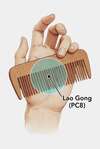
Mécanisme 1 : Activation du portillon. La pression ferme et répétée stimule les fibres Aβ, qui « ferment le portillon » aux signaux des fibres C issues des contractions. Le cerveau ne peut traiter pleinement qu’un nombre limité de stimuli sensoriels simultanés. La sensation tactile intense dans la main concurrence la douleur utérine, réduisant sa perception subjective. Des ressources sur la gestion de la douleur en obstétrique, comme celles d’Evidence Based Birth, soulignent que des techniques de contre-stimulation (pression, massage, TENS) exploitent précisément ce principe et montrent une efficacité dans la réduction de l’intensité douloureuse.
Mécanisme 2 : Acupression et libération d’endorphines. La stimulation du point Lao Gong est associée à une réduction de l’anxiété et à une augmentation de la production d’endorphines et d’ocytocine. Des études sur l’acupression en général (points comme LI4 ou SP6) démontrent une diminution significative de la douleur du travail et une réduction du recours aux analgésiques. Une revue systématique a montré que l’acupression pouvait réduire l’intensité de la douleur et améliorer la satisfaction des parturientes. Bien que les études spécifiques sur le « birth comb » soient encore limitées (principalement des observations cliniques et témoignages), elles s’inscrivent dans ce corpus robuste.
Mécanisme 3 : Distraction cognitive et sentiment de contrôle. Serrer le peigne offre un point focal concret : synchroniser la pression avec le rythme des contractions aide à maintenir une respiration contrôlée et à rester présente. Cela diminue l’anxiété, facteur amplificateur de la douleur via les voies descendantes modulatrices (système opioïde endogène et noradrénergique). Des recherches sur les techniques de coping actif confirment que le sentiment d’auto-efficacité réduit la perception douloureuse et peut raccourcir la durée du travail.Entrez votre texte ici
Preuves et limites
Des méta-analyses sur les méthodes non pharmacologiques (massage, acupression, immersion) montrent des réductions modérées à importantes de la douleur et des interventions médicales. Par exemple, l’acupression réduit le score de douleur de 1 à 2 points sur une échelle visuelle analogique dans plusieurs essais randomisés. La technique du peigne, popularisée dans les communautés de naissance naturelle, bénéficie d’un effet cumulatif avec d’autres outils (balle de naissance, mouvement, soutien continu).
Cependant, les preuves spécifiques au peigne restent majoritairement anecdotiques ou de niveau observationnel. Son efficacité varie selon les femmes, leur seuil de tolérance et le contexte (soutien, environnement). Elle ne remplace pas une péridurale en cas de besoin, mais constitue un outil complémentaire sûr, gratuit et sans effet secondaire.
Utilisation du peigne
Choisissez un peigne aux dents solides et non tranchantes. Placez-le dans la paume, serrez pendant la contraction (en expirant profondément) et relâchez entre deux. Associez-le à des positions verticales ou du mouvement pour optimiser la descente du bébé. Informez votre accompagnant pour qu’il vous le rappelle si nécessaire.
En conclusion, tenir un peigne dans la main pendant l’accouchement n’est pas une solution miracle, mais une application concrète et accessible de principes neuroscientifiques solides. En activant le portillon spinal, en stimulant l’acupression et en renforçant le contrôle cognitif, cette technique peut transformer la gestion de la douleur, rendant l’expérience plus empowering. Chaque naissance est unique : tester cette méthode simple dans votre préparation peut faire une différence significative. Consultez toujours votre équipe soignante pour l’intégrer à votre projet de naissance.
L'ostéopathie peut aussi vous aider
Si vous cherchez d’autres astuces naturelles pour faciliter votre accouchement, n’hésitez pas à consulter un ostéopathe spécialisé en périnatalité. Cet expert pourra vous accompagner avec des conseils personnalisés et adaptés à votre morphologie. Il travaillera particulièrement sur la mobilité mécanique du bassin (sacrum, iliaques et symphyse pubienne), zone clé pour permettre une meilleure descente du bébé et un passage plus harmonieux. Mais il n’oubliera pas le reste du corps : libération des tensions au niveau du diaphragme, de la colonne vertébrale, des hanches et même de la mâchoire, afin d’optimiser votre posture globale et de favoriser une meilleure gestion des contractions. Une préparation ostéopathique bien menée peut ainsi contribuer à un travail plus efficace et moins douloureux.
Marie Messager
Ostéopathe D.O
2 rue Alexis de Tocqueville
78000 Versailles